
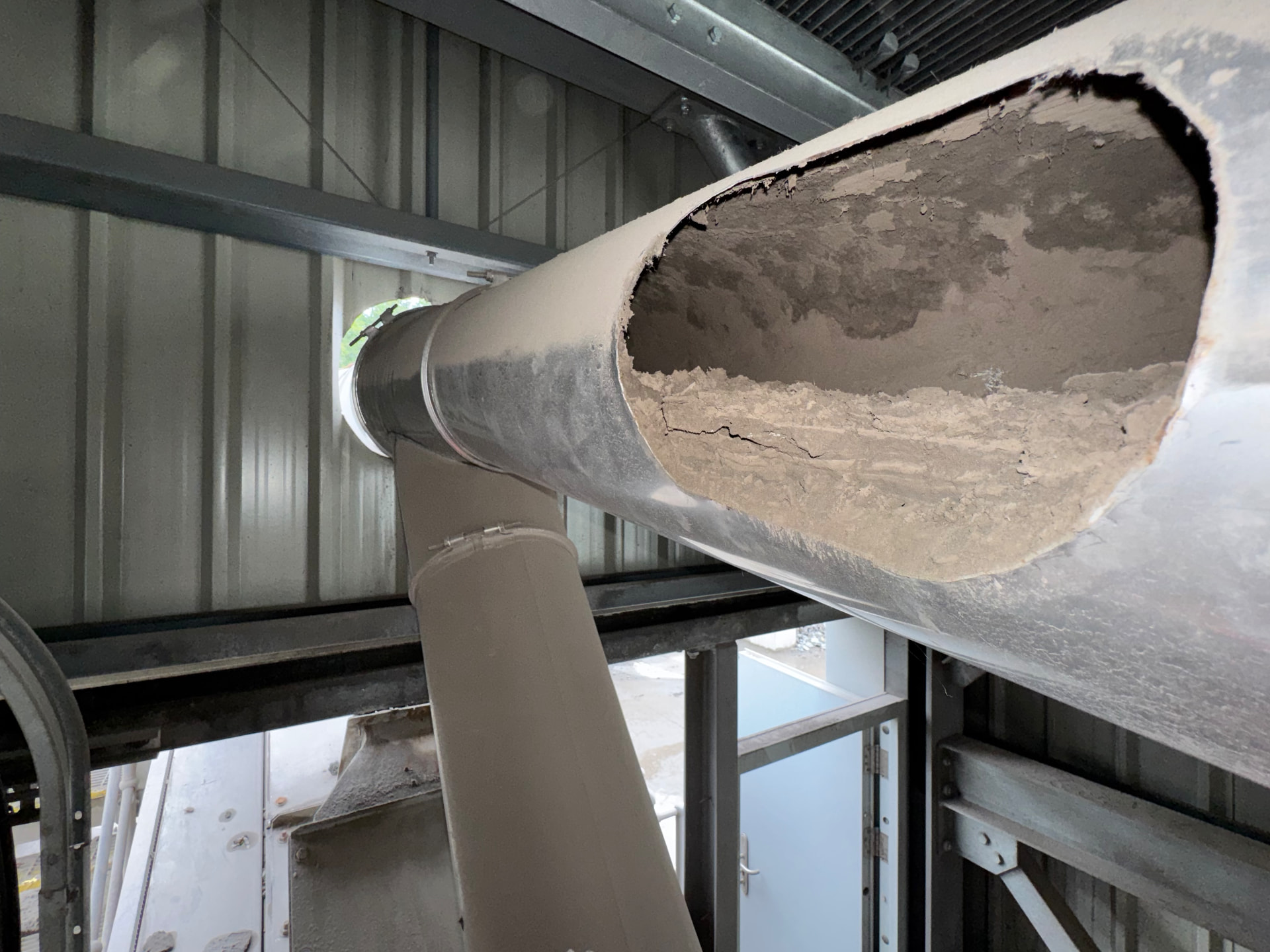
Common contaminants found inside commercial ductwork
Every ventilation system collects material. What it collects depends on the building, and it tells you a great deal about how the system is performing.
Common contaminants found inside commercial ductwork
General particulate
Fine dust, textile fibres, paper fibres and skin cells make up the bulk of deposit in a typical office or education supply system. Individually harmless, in quantity it reduces duct cross-section, loads filters faster and provides a substrate for other contamination to settle on.
Grease and cooking residue
Confined to kitchen extract systems and any general system drawing air from a catering area. Combustible, adhesive and cumulative, and the reason kitchen extract is treated separately under TR19 Grease rather than as general ventilation hygiene.
Moisture, mould and microbial growth
Where humidity is high or drain trays are blocked, damp deposit can support microbial growth. It is most commonly found in AHU cooling sections, around poorly draining condensate trays and in extract systems serving pools, kitchens and laundries. It produces the characteristic musty odour occupants describe long before anyone inspects the plant.
Process contamination
- Wood dust in joinery and furniture manufacture
- Metal fines and welding fume residue in fabrication
- Powder and product dust in food and pharmaceutical production
- Resin, paint overspray and solvent residue in finishing operations
- Lint and fibre in laundry and textile extract
Construction debris and foreign objects
It is remarkably common to find installation debris still inside ductwork years after handover: offcuts, insulation fragments, packaging, and occasionally tools. Ductwork installed without protective capping during construction can be substantially contaminated before the building is even occupied, which is why pre-handover cleanliness verification is worth specifying on new builds and refurbishments.
How contamination is assessed
Assessment is by internal inspection at representative points, supported by measurement — deposit thickness for grease systems, and recognised surface sampling methods for general ventilation. The measured result is what allows a cleaning frequency to be set defensibly and compared against the next inspection.
Continue reading
Services and guidance related to this article.
Ventilation System Inspection
Condition assessment, hygiene verification and cleaning recommendations.
Commercial Ductwork Cleaning
TR19-aligned cleaning, verification and reporting for supply and extract systems.
Industrial Ductwork Cleaning
Process extraction and factory ductwork cleaned around production.
Request a free site survey
Tell us about your site and a Deduct engineer will arrange a no-obligation survey, scope of works and written quotation.