
How do air ducts work?
Ductwork is one of the least visible and most consequential systems in a commercial building. This is how it actually works, and where performance is usually lost.
How do air ducts work?
The basic principle
A ventilation system is a pressure circuit. A fan creates a pressure difference, air moves along the path of least resistance, and ductwork directs that movement to where it is needed. Supply ductwork carries conditioned air from an air handling unit into occupied spaces through diffusers and grilles. Extract ductwork carries stale, humid or contaminated air away from those spaces and discharges it outside.
In most commercial buildings the two run as a balanced pair. Take too much out and the building goes negative, pulling unconditioned air in through doors and gaps. Push too much in and doors become difficult to open and conditioned air escapes. Commissioning sets that balance; time, dirt and alterations gradually degrade it.
What sits in the circuit
- Air handling unit — fans, filters, heating and cooling coils, and often heat recovery
- Supply and extract ductwork — rigid rectangular or circular sections, plus flexible connections
- Dampers — for volume control, fire and smoke separation, and zone isolation
- Terminal devices — diffusers, grilles, VAV boxes and fan coil units
- Access panels — the only practical way to inspect and clean the system internally
Why systems lose performance
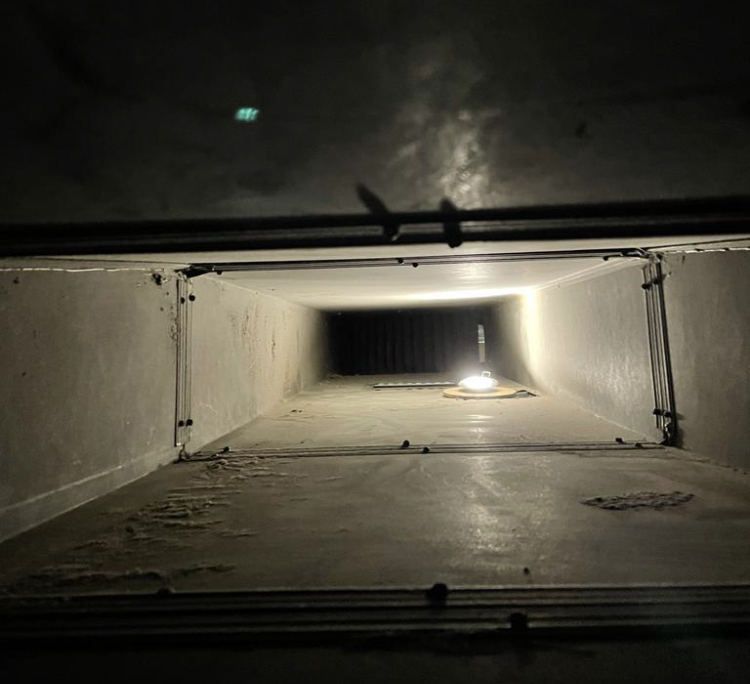
Air is never clean. Even with filtration, fine dust, fibres, skin cells and moisture enter the system and settle on internal surfaces, particularly at bends, dampers and low-velocity sections. Deposits reduce the effective cross-section of the duct, increase resistance and force the fan to work harder for less airflow.
The effects appear gradually and are usually blamed on something else: rooms that will not hold temperature, rising energy consumption, complaints about stuffiness, dust marking around diffusers, and filters needing changing more often. In kitchen extract systems the deterioration is faster and the consequence is more serious, because the deposit is combustible grease rather than dust.
What keeps a system working
Three things: filtration that is changed on schedule, ductwork that is inspected and cleaned at a frequency matched to how the system actually loads, and documentation that records the condition each time so you can see the trend rather than guess at it.
Inspection is the part most often skipped, usually because the system was built without adequate access panels. That is a solvable problem and it is cheaper to solve than the energy and comfort losses that come from never looking inside.
Common questions
- How do I know if my ductwork needs attention?
- Reduced airflow at diffusers, dust marking around grilles, rising fan energy, filters loading faster than expected and occupant complaints about air quality are all common indicators. A survey with internal inspection confirms it.
- Does cleaning ductwork improve energy performance?
- It can. Removing deposits reduces system resistance, which means the fan achieves design airflow at lower power. The gain depends on how heavily loaded the system was to begin with.
Continue reading
Services and guidance related to this article.
Request a free site survey
Tell us about your site and a Deduct engineer will arrange a no-obligation survey, scope of works and written quotation.